Showing posts with label astronomy. Show all posts

Bad Eclipse Photos, but Totality Worth It

 I didn't intend to take a lot of quality photos during the 2024 solar eclipse, for one simple reason: Lots of people would get much better pictures, so why worry?

At the entrance to Summit Lake State Park, which is--I don't know--in Central Indiana somewhere, we saw a car that advertised an owner who was really serious about the Search for ExtraTerrestrial Intelligence. I'll bet that entire luggage rack held camera equipment.


We parked right beside a guy who told us he drove here from Colorado, after first planning to see the eclipse in Texas. His instincts were right on: He barely missed hurricane force winds in his home state, and avoided driving into rainstorms down south. Above is his telescope/camera, which took a time lapse of the eclipse and set him back about five thousand bucks.

The cost of my camera? Well, take off a zero, for starters.

Then there was the family that set up on the other side of us:

I don't know where they were from, but they were also very nice folk who, despite having kids, clearly didn't lack spending money.

I experimented, and managed to get this photo pre-totality, by putting eclipse glasses over the lens. This worked only when I forgot to turn off the flash, for which I have no explanation.

I told you all that to explain why I'm very proud of this last photo. No, it's nowhere good as the more experienced photographers with more expensive setups, but honestly, I didn't expect to get this at all:


It wasn't about getting photos, not for us. It was about experiencing it. After seeing the one in 2017, we knew that if we got lucky and the weather broke out way, we were in for an unforgettable experience. We were right. Totality worth it.


Remember: Keep an eye on the skies--unless you're driving.


Dimming Hopes: A Veil Of Clouds Might Shroud the Eclipse

 I'm a huge astronomy geek. The only way I could get more excited about the upcoming solar eclipse would be if it caused chocolate to fall from the sky.

Just the same, the fuss going on ahead of the April 8th event has passed the hubbub stage, and gone straight into a hullabaloo. I feel compelled to throw some water on the excitement ... and that may be close to literal, in this case.

In 2017 Emily and I drove from her father's house to a state park in Missouri to be in the path of the total eclipse. Even though it was in the middle of nowhere, a good crowd showed up on a very hot August day.

There's your first sign of trouble: August weather is different from April weather. In fact, the odds are it'll be cloudy on the 8th, and it's a short jump from there to rain. In one of my novels a character does a rain dance, but I'm not sure an anti-rain dance even exists.

In the path of totality it'll still be interesting even if it's cloudy. Well, probably: I've only been to one total eclipse, and up until the moment it disappeared the Sun was ripping off our skin.

https://cms.accuweather.com/wp-content/uploads/2023/03/2024-eclipse-cloud-climatology.jpg

Now, I've witnessed several partial eclipses, and they're pretty cool even if you have to look at them through dark glasses. It turns twilight, and sometimes you can see the shape of the eclipse on the ground, focused through tree branches.

But they're nothing like a total eclipse. Nothing. A total eclipse is literally breathtaking. Nature seems to stand still, the wind dies, stars and planets come out. For an brief, incredible moment as the Moon completely covers the Sun, you can look directly at it.

The problem is, the area of the total eclipse is just a hundred miles or so wide.


I haven't heard that talked about a lot, and I'm afraid people not directly in the path are going to be disappointed. Where I live and in the closest city, Fort Wayne, the Sun will be over 90% covered, but not totally. It will NOT be safe at any time to look at the Sun without special protection. It'll still be cool if you're into that kind of thing, as I am.

But we're driving south, to be in the path of totality. It's a long wait for a short event, but it's worth the wait. Besides, it's just as likely to be cloudy here as there. That's the reason why officials are so worried about traffic on eclipse day, especially right after totality: People crowding into that 100 mile long strip, then heading for home.

In 2017 that wasn't a problem for Emily and me: We got there early, and afterward we hit the park trails for a few hours, until the traffic had cleared some. That's our plan this time, too. We'll have a full tank of gas, snacks, fluids, cell phones and their chargers, a few issues of "Writer's Digest", and some print books, too. Hopefully we'll find a place near a bathroom.

So there are your dual problems: Anyone from around here and in many other places will have to travel to see the full eclipse, and even those who don't are likely to find their view spoiled by typical Midwest spring weather. Add the expected traffic jam for an event that will climax over a period of about four minutes, and you could be forgiven for staying where you are and watching most of the sun disappear through eclipse glasses.

But us? We can't wait.


Remember: reading a book is way safer than looking into the sun ... depending on which book.

Apollo: One Giant Leap For Mankind

It was one of my earliest memories.

Six days earlier, I turned seven. It was one heck of a birthday present.

Human beings landing on the surface of another heavenly body. It's hard to remember, fifty years after, just how remarkable that was. In 1969 it had been only twelve years since anything made by humans was launched into orbit, let alone 300,000 miles further on to the Moon.Only eight years before (fourteen months before my birth), the first American was shot into space.

It was all new.

I remember it being taller.

Cars were being designed with rocketship-like fins on them. Star Trek and Lost in Space were on TV. (My very earliest memory is hiding behind my mother while she ironed clothes and watched a particularly scary scene from Star Trek.) My Christmas gifts? Action figures from the Matt Mason astronaut collection, and a complete Apollo rocket that, with a click, shot the Apollo capsule into the air.

We were space nuts because space was, perhaps literally, the future.

Or so we thought.

"I'm Matt Mason, and I"m bendy!"
 I remember one aunt claiming that the Moon landings never really happened. Yes, that was a thing even back then. The rest of us sat transfixed in front of our television sets, which themselves were the size of an Apollo capsule, and similarly colorless. We watched the launches, the landings, the splashdowns, even the retrieval as helicopters set the capsules down on the deck of a handy aircraft carrier.

One day our teacher brought a portable TV into the classroom--by portable, I mean it could be picked up by one person, assuming that one person had been working out. She adjusted the rabbit ears until a kinda-sorta picture came on, and we sat silently, watching one of the Apollo capsules splash down in the Pacific.

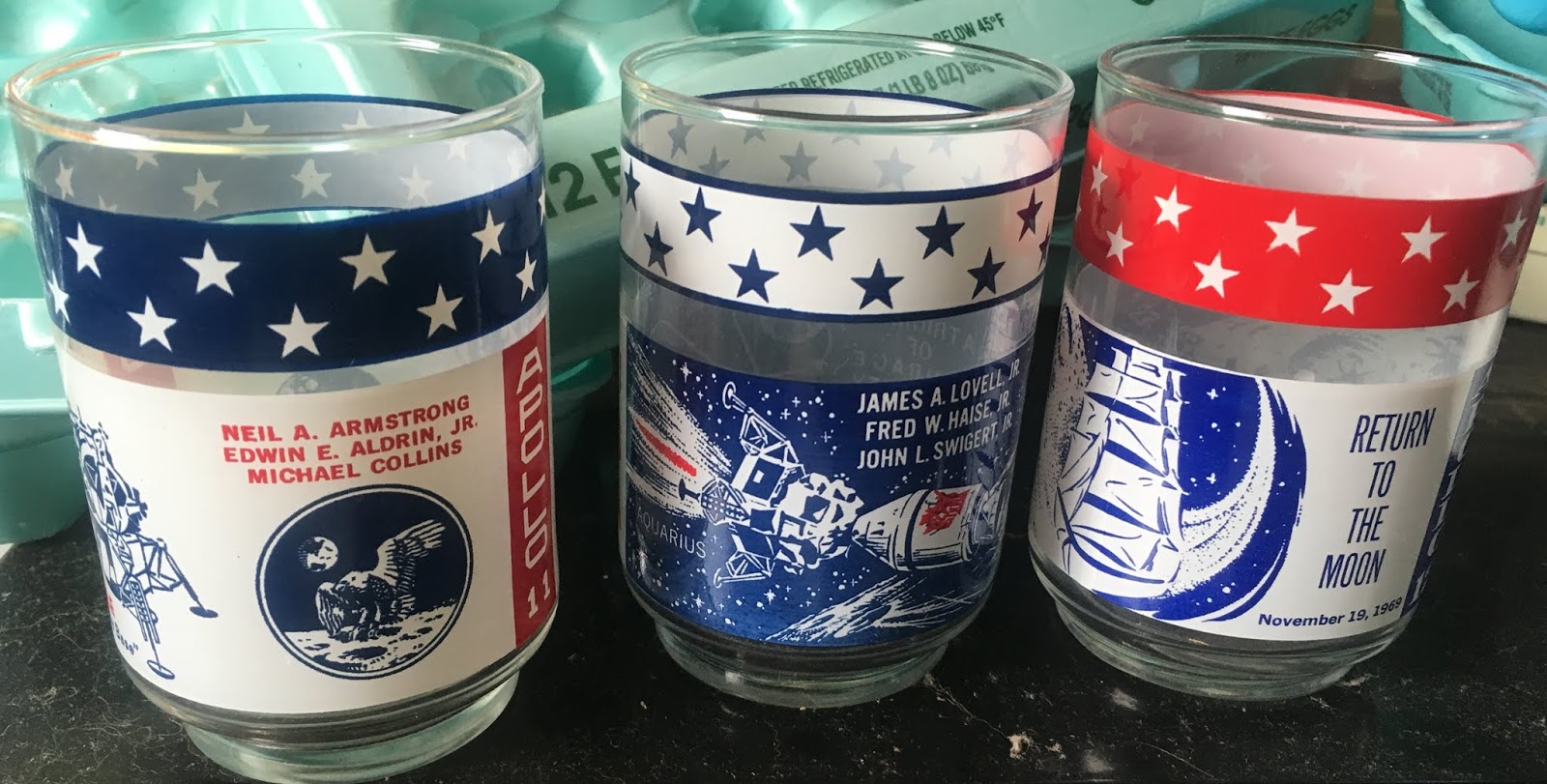
Thanks to Dee Williams, who gave me these as a reminder of the kitchen's piece of Apollo.


It was an early experiment in bringing technology into the classroom, and it sure worked for us ... although I wouldn't see a TV in class again until high school.

Oddly enough, I have no memory of the Apollo 13 crisis, and I wonder now if my parents didn't keep the news from me. Maybe they figured, correctly, that I had anxieties of my own without learning that my real life heroes were only human, after all. But otherwise, I was all about space.

Just to be clear, this is the real thing.
Can it really have been fifty years?

What the hell happened? We were supposed to be on Mars by now. Where's the Moonbase? Why isn't Southwest Airlines booking cheap flights to a space station? Where the heck are the ray guns, and the communicators?

Well, okay, never mind the communicator.

I was supposed to be up there, dammit. During winter I'd tie the hood of my coat tight around my face, and pretend I was in a spacesuit. Granted that space is warmer than Indiana winters of my youth, but still.

I'm what people call a fiscal conservative. I don't think any government should spend beyond their means, and I'm very much against throwing money around just because you can print more. Heaven knows manned space exploration is almost as expensive as a presidential election campaign.

But this is one area in which we should be spending more.

"That's one small step for half a billion ..."
The advantages of space exploration are enormous. Big enough to justify the expense, with all the other problems in the world? I would argue yes, but not just the missions themselves. It requires an investment in science, and that requires an investment in people: education, interest, employment. Discoveries that will lead to another wave of innovation and invention. Imagine the materials, knowledge, and technology that came out of the Apollo era, and imagine that continuing on, with a new generation.

A new generation. I think one of the problems with the world today is that we've lost our love of discovery just for the sake of discovery. Yes, exploration can bring us that new technology, those new jobs, maybe solutions to today's problems. But more important than that, it's time to make kids wonder again.

We need to be able to sit our kids in front of the TV again, and let them see real wonders, going on right before their eyes. Well, maybe not TV; maybe online, or on their phones, or visors, or their cyber-optic implants. Mankind has always thrilled in that exploration, that discovery. Reestablishing manned space exploration--preferably as a species, rather than as a country--might be just what it takes to get us moving forward as a people again.

Okay, so maybe it's too late for me to go up there. But I have grandchildren, now. And maybe, fifty years from now, people will be telling the story of when they landed ... somewhere.